
A smart plug for air conditioner control sounds simple: plug in the AC, connect the smart plug to Wi-Fi, and gain schedules, remote control, and energy monitoring. The problem is that air conditioners are not simple lamp loads. They use compressors and motors that can draw a much higher current when starting than they do while running.
That means a smart plug that says “15A” or “16A” on the box is not automatically suitable for an air conditioner. The plug’s motor-load rating, the AC’s startup behavior, voltage, plug type, and manufacturer instructions all matter.
This guide explains what to check before using a smart plug with a window or portable AC, when to avoid one, and which alternatives make more sense for split systems or high-load units.
Can You Use a Smart Plug With an Air Conditioner?
Sometimes, but not by current rating alone.
Many smart plugs are designed mainly for resistive loads such as lamps, kettles, irons, or heaters. Air conditioners are different because the compressor is a motor-driven inductive load. When that compressor starts, it can create a short surge of current that is much higher than the normal running current.
TP-Link’s current Tapo/Kasa guidance specifically warns that high-power motor loads such as air conditioners can create startup inrush current that exceeds a smart plug’s supported load, even when the plug’s headline wattage looks high enough. Its supported motor/compressor limit also changes by model and region. See TP-Link’s official smart-plug load guidance.
Air-conditioner manufacturers can be even stricter. GE Appliances says its room air conditioners should be connected directly to a properly grounded wall outlet rather than an extension cord, surge protector, or multi-outlet adapter. LG manuals similarly specify grounded outlets and dedicated circuits for many room AC models.
So the safest rule is simple: the AC manual and the smart plug’s motor-load specification both have to agree with your setup.
7 Things to Check Before Using a Smart Plug for Air Conditioner Control
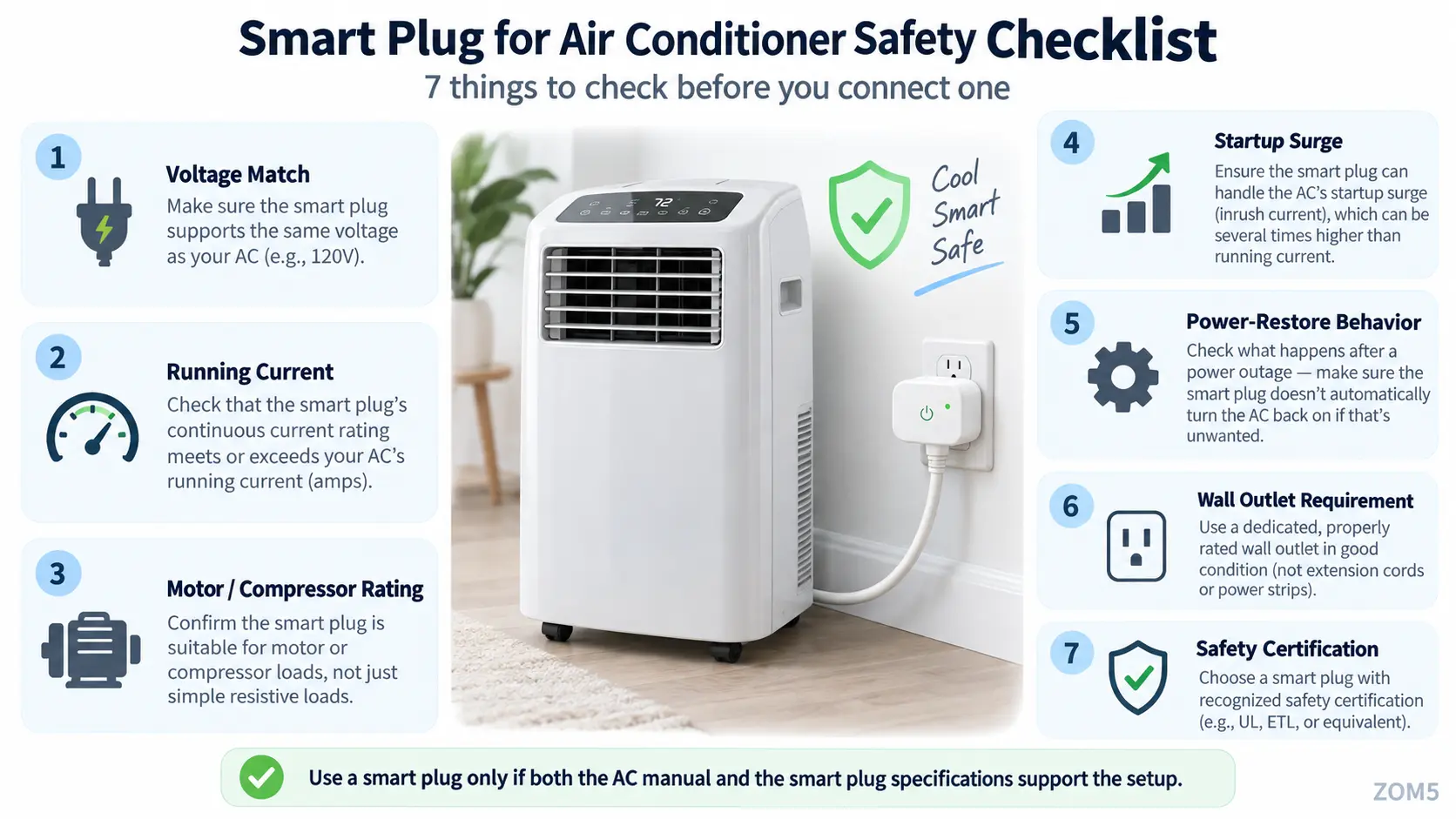
1. Check the AC’s voltage
Start with the nameplate on the air conditioner. In North America, many smaller room ACs use 115–120V, while larger models may use 208–230V. In the UK, Australia, and many other countries, household supply is around 230V.
Your smart plug must match the AC’s voltage and plug/receptacle type. A 120V smart plug is not a solution for a 230V room AC, even if the app and features look perfect.
2. Check the running current, not just watts
Look for amperage on the AC nameplate or manual. If the unit lists watts, current can be estimated from voltage and watts, but the appliance label is better because AC systems can have power-factor and compressor behavior that make simple math less useful.
Do not choose a smart plug that operates right at its maximum rating. A compressor load deserves margin, not a paper-thin match.
3. Check the motor or compressor rating
This is the detail many generic “best smart plug” lists miss.
A smart plug may advertise 15A or 16A for general use but have a much lower motor rating. TP-Link, for example, publishes separate motor/horsepower limits for different Tapo plug models. Some models that can handle high resistive wattage are still limited to relatively small motor loads.
For a smart plug for air conditioner use case, the motor/compressor rating matters at least as much as the headline amp rating.
4. Account for startup or inrush current
When a compressor starts, it may draw a brief surge above normal running current. That is one reason a smart plug can fail even though the AC seems to run well below the plug’s advertised maximum during steady operation.
Modern variable-speed and inverter ACs may behave differently from older fixed-speed compressors, but you should not assume “inverter” means any smart plug is safe. Use the AC manufacturer’s electrical requirements and the smart plug manufacturer’s supported-load guidance.
5. Check what happens after power is restored
A smart plug controls power to the AC. That only works if the AC behaves the way you expect when power returns.
Some window or portable units resume their previous settings after a power interruption. Others stay off until you press the power button. If your AC does not automatically restart, a smart plug may be useless for remote turn-on even when the electrical side is compatible.
Test this behavior using the AC’s normal power source and follow its manual. Do not repeatedly hard-cycle the compressor just to experiment.
6. Read the AC manual for direct-wall-outlet requirements
This point can override everything else.
GE Appliances states that its room air conditioners should be plugged directly into a properly grounded wall outlet and not used with an extension cord, surge protector, or multi-outlet adapter. LG documentation for many models also calls for a dedicated grounded circuit and warns against extension cords.
You can review GE’s air-conditioner electrical guidance and your own model’s manual before adding any intermediate device between the AC and wall.
7. Check certification and protection features
If the manufacturer allows a smart-control intermediary, use a reputable product with proper safety certification for your market. In the U.S. and Canada, that commonly means products evaluated by recognized testing laboratories such as UL or ETL. Other regions have their own electrical conformity requirements.
Useful features include:
- published motor or inductive-load rating
- overload protection
- over-temperature protection
- energy monitoring
- clear maximum current and voltage specifications
- a grounded connection where the AC requires one
A cheap no-name plug with a big wattage number but no clear motor-load data is not the place to save money.
Window vs Portable vs Split AC: Which Can Work With a Smart Plug?
Window air conditioners
Small plug-in window ACs are the most likely candidates for smart-plug control, but only when the AC manual allows an intermediate device and the plug is rated for the compressor load.
Many newer window units already include Wi-Fi or connected functionality. ENERGY STAR notes that many modern room air conditioners offer remote control, scheduling, and energy-use feedback without a separate smart plug. See the ENERGY STAR room air conditioner guide.
Portable air conditioners
Portable ACs also commonly use a standard plug, so they look like easy smart-plug candidates. The same electrical checks still apply. A portable AC can have a substantial compressor and startup surge even if it rolls around on wheels.
Also check whether the unit uses a current-interrupter or leakage-protection plug. Do not defeat or bypass any protection built into the AC’s power cord.
Split and mini-split air conditioners
A normal smart plug is usually the wrong approach for a split system. Many mini-splits are hardwired or supplied from a dedicated circuit, and some are designed to remain powered continuously while their internal electronics manage the compressor.
For split ACs, a smart IR controller, the manufacturer’s Wi-Fi module, a compatible thermostat interface, or a professionally installed control solution is usually more appropriate.
Why a 15A or 16A Smart Plug Is Not Automatically AC-Safe
This is the most important misconception around a smart plug for air conditioner setups.
A 15A rating often tells you the maximum general current under specified conditions. It does not necessarily tell you how the plug’s internal relay handles a motor’s startup surge. That is why reputable manufacturers sometimes publish separate limits for motors, pumps, or horsepower.
Two smart plugs can both say “15A” and still have very different suitability for compressor loads.
For AC control, compare all of these:
- voltage
- continuous current
- maximum power
- motor or horsepower rating
- inrush or startup-current guidance
- manufacturer-approved load types
If the motor rating is missing, that is a reason to ask the manufacturer rather than assume.
Safer Smart-Control Alternatives for Air Conditioners
1. Use the AC’s built-in Wi-Fi
If your air conditioner already offers app control, this is usually the cleanest option. The AC stays connected exactly as its manufacturer intended while you still get remote power, scheduling, and temperature control.
2. Use a smart IR controller
For many split ACs and portable units that use an infrared remote, a smart IR controller can copy remote commands without switching mains power to the compressor.
This is especially useful in a smart home apartment where you want reversible upgrades with no electrical work.
The limitation is compatibility: the IR controller must support your AC’s remote codes, and it usually needs line of sight to the indoor unit.
3. Use a manufacturer-supported thermostat or interface
Some systems support thermostats, accessory Wi-Fi modules, or home-automation interfaces. These solutions communicate with the AC’s controls instead of repeatedly cutting power.
4. Use an electrician-installed contactor or load controller when appropriate
For larger hardwired loads, the right solution may be a properly rated contactor or smart load controller installed by a qualified electrician. This is not the same thing as plugging a consumer smart outlet into the wall.
If mains wiring is involved, follow local electrical codes and use a qualified professional.
Common Smart Plug + AC Mistakes to Avoid
- Buying by wattage alone. Compressor startup current can matter more than steady-state wattage.
- Ignoring motor ratings. A plug can support 15A resistive load and still have a much lower motor limit.
- Using extension cords or power strips. Many AC manufacturers require direct connection to a wall outlet.
- Using a smart plug with a hardwired split AC. Use an approved control method instead.
- Rapid on/off automation. Frequent hard cycling can stress a compressor. Respect any restart delay specified by the AC manufacturer.
- Assuming remote power equals remote start. Some ACs do not turn back on automatically after power returns.
- Using uncertified no-name devices. High-load appliances deserve products with clear specifications and recognized safety certification.
What Features Matter Most If Your AC Is Compatible?
If you have confirmed that your exact AC and smart plug can safely work together, then smart features become relevant.
- Energy monitoring: useful for seeing how much power the AC actually uses.
- Schedules: helpful for turning off a compatible room AC after a set period.
- Auto-off timers: good for preventing accidental all-day operation.
- Overload alerts: valuable on high-load devices.
- Matter/Alexa/Google/Apple support: useful only after electrical compatibility is confirmed.
- Reliable local button: lets you control the outlet if Wi-Fi is unavailable.
Electrical compatibility comes first. Smart-home ecosystem support comes second.
Frequently Asked Questions
Can I use a 15A smart plug with a 15A air conditioner?
Not based on those two numbers alone. You also need to check voltage, the AC’s actual running current, compressor startup current, the smart plug’s motor/horsepower rating, and both manufacturers’ instructions.
Can I use a 16A smart plug for an air conditioner?
Possibly, but a 16A headline rating does not guarantee suitability for a compressor load. Check the plug’s published motor or inductive-load rating and the AC’s electrical requirements.
Is a smart plug safe for a window AC?
It can be for some models if the manufacturer allows it and the smart plug is properly rated for the compressor. Many room AC manufacturers recommend direct wall connection, so check the manual first.
Can a smart plug control a split AC?
Usually not in the normal plug-in sense. Split systems are often hardwired or connected to dedicated circuits. A smart IR controller, built-in Wi-Fi, or manufacturer-supported interface is usually a better solution.
Will a smart plug save money on air conditioning?
A smart plug does not make the AC itself more efficient. It can reduce wasted runtime through schedules, remote shutoff, or energy monitoring. A properly sized efficient AC and sensible temperature settings have a bigger impact on energy use.
What is better than a smart plug for an AC?
If available, use the AC’s built-in Wi-Fi or manufacturer-supported smart controls. For remote-controlled split systems, a compatible smart IR controller can add app and voice control without switching the compressor’s mains power.
Final Thoughts
A smart plug for air conditioner control can be useful, but this is one smart-home upgrade where “it fits the socket” is not enough.
Check the AC’s voltage, running current, startup behavior, plug type, and manual. Then check the smart plug’s motor/compressor rating, not just its headline amp or wattage number.
If either manufacturer does not support the setup, choose built-in Wi-Fi, a smart IR controller, or a properly engineered control solution instead. Convenience is useful, but electrical compatibility comes first.