
Choosing bedside lighting sounds simple until you have to decide where the light should actually live. A table lamp is familiar, easy to move and simple to replace. A wall sconce frees the nightstand and can make a bedroom feel more intentional, but it also asks more from the wall, the layout and sometimes the wiring.
So when comparing wall sconces vs table lamps for a bedroom, there is no universal winner. The better choice depends on your nightstand size, whether you rent, how often you rearrange the room, how you read in bed and how permanent you want the setup to feel.
This guide focuses on the practical differences that matter beside a bed rather than treating one fixture type as automatically better.
Choose table lamps if you rent, rearrange furniture often, want the easiest installation or prefer a softer decorative glow.
Use both when one source handles reading and the other handles ambient light.
Wall Sconces vs Table Lamps: The Main Difference
The core difference is not really about brightness. It is about where the fixture lives.
A table lamp sits on furniture. That makes it easy to place, move and replace, but the lamp base and shade consume some of the nightstand surface. A wall sconce moves the fixture onto the wall, giving the tabletop back to you, but the light becomes more fixed once mounted.
That one difference affects almost everything else: installation, visual weight, flexibility, reach, cord management and how easy the room is to change later.
If you are still planning the overall room rather than only bedside lights, our bedroom lighting guide explains how ambient, task and accent lighting work together.
Quick Comparison: Which One Wins Where?
Tradeoff: mounting is more permanent and placement needs more planning.
Tradeoff: the base and shade use valuable surface space.
Tradeoff: more fixtures, more visual planning and potentially more cords.
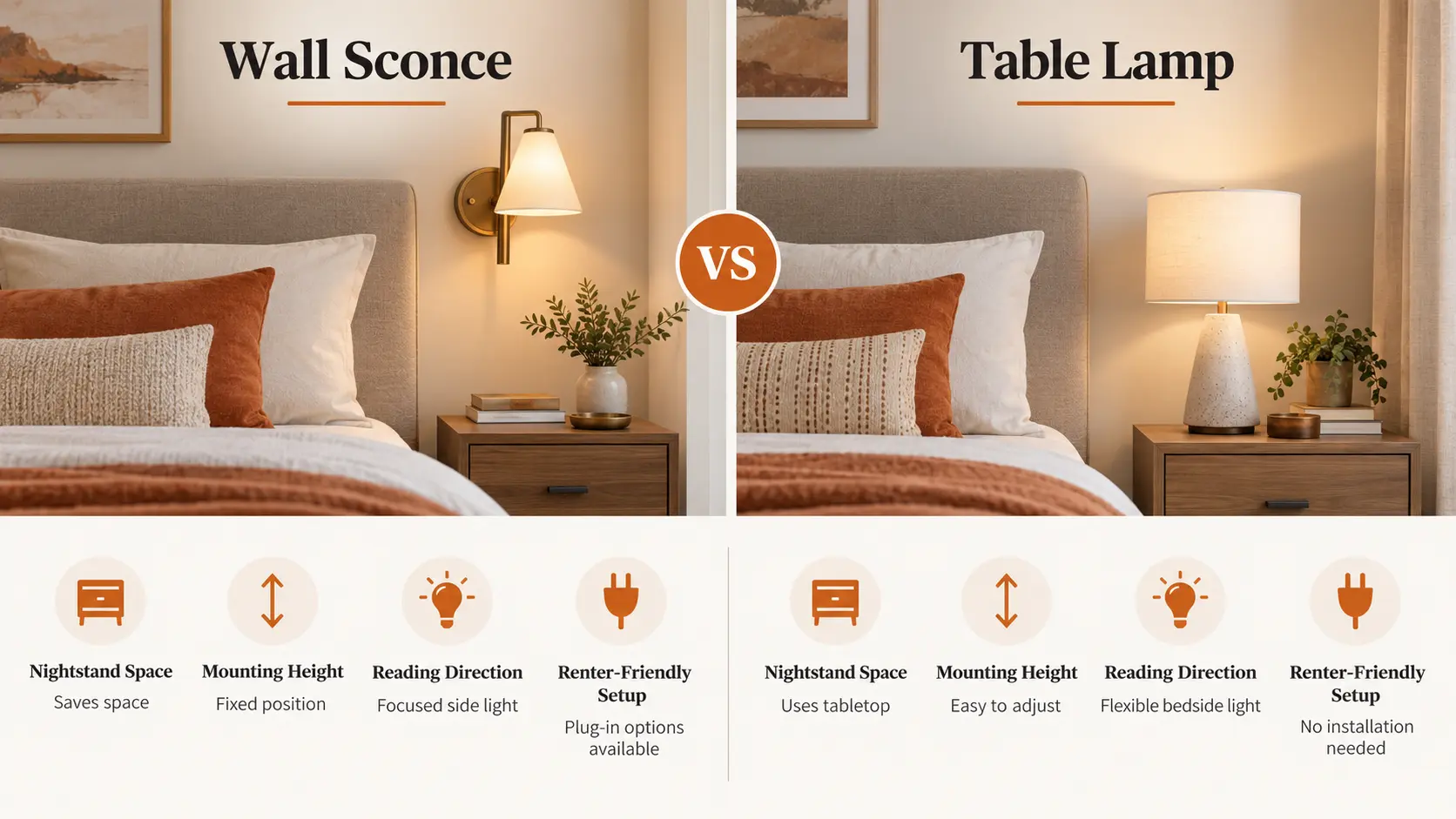
1. Nightstand Space: Wall Sconces Win
This is the clearest advantage of a wall-mounted light. If your nightstand is narrow, a lamp base can take up a surprising amount of usable space. Add a phone, charger, glass of water, book and a few everyday items, and the surface quickly feels crowded.
A wall sconce removes the lamp footprint entirely. This matters even more when the bedside surface is a small floating shelf rather than a full nightstand.
For a large bedroom with wide nightstands, the space saving may not matter much. A properly sized table lamp can actually help the furniture feel visually complete. But in compact rooms, freeing even a small surface can noticeably improve how the bedside area works.
If this is your main reason for considering sconces, see our guide to the best plug in wall sconces for bedrooms. Plug-in models can give you the space-saving benefit without requiring new hardwired electrical work.
2. Installation and Renter-Friendliness: Table Lamps Win
A table lamp is difficult to beat for simplicity. Put it on the nightstand, plug it in and position it where the light feels comfortable. If you move the bed, change the furniture or move to another home, the lamp moves with you.
Wall sconces come in several forms:
- Hardwired sconces can create the cleanest look but usually involve electrical work and a more permanent placement.
- Plug-in sconces mount to the wall but use a normal outlet, making them easier to add without opening the wall.
- Rechargeable or cordless sconces reduce visible cords, although charging and battery management become part of the routine.
For renters, a table lamp is normally the safest default because there is little or no wall repair when you leave. A plug-in sconce can still work if your lease allows mounting holes and you are comfortable patching them later.
Do not assume that “plug-in” means “no installation.” The fixture still needs to be mounted securely and positioned where the cord and switch are convenient.
3. Reading in Bed: The Better Fixture Depends on Direction
For reading, brightness alone is not enough. The useful question is whether the light reaches the page without shining directly into your eyes or flooding the other side of the bed.
A swing-arm or directional wall sconce can be excellent for reading because the light position stays consistent and the beam can be aimed toward the book. In a shared bedroom, separate sconces on each side can also give each person more independent control.
A table lamp can work just as well when the shade height, nightstand height and bed height line up properly. It also gives you more freedom to move the lamp closer or farther away if the room layout changes.
If focused nighttime reading is the priority rather than general bedside ambience, our guide to the best reading lights for bed includes wearable, clip-on and headboard options that can be even more targeted than either a traditional sconce or lamp.
What matters more than fixture type?
- A switch you can reach comfortably from bed
- A beam or shade that controls glare
- Enough light on the page without lighting the whole room
- Dimming when possible
- Warm evening light rather than an unnecessarily cool, harsh tone. The U.S. Department of Energy notes that lower color temperatures such as 2700K produce a warmer appearance that is commonly used in homes.
For the wider room, our bedroom lumen guide explains why task lighting should be treated separately from the total ambient-light target.
4. Style and Visual Balance: It Depends on the Room
Wall sconces tend to create a more architectural look because they become part of the wall composition. Matching fixtures on both sides of a headboard can give the bed a balanced, hotel-inspired appearance and make the nightstands feel lighter.
Table lamps usually feel softer and more decorative. The shade, base material and scale add another object to the furniture arrangement, which can help a large nightstand feel less empty.
Neither approach is automatically more stylish. The important part is proportion.
A tiny sconce above a wide king-size headboard can disappear visually. A large lamp on a narrow nightstand can make the bedside area feel crowded. The fixture should make sense with the width of the bed, the size of the nightstand and the amount of wall space around it.
For table-lamp options across different bedroom styles, see our best table lamps for bedrooms guide.
5. Flexibility and Future Changes: Table Lamps Win
If you like changing the room every year or two, table lamps are easier to live with. You can swap the lamp, move the nightstand, rotate the bed or completely change the bedroom layout without worrying about old mounting points.
A wall sconce rewards planning. Once you find the correct height and position, it stays visually tidy and predictable. But if the bed moves six inches or the headboard gets taller, the fixture may suddenly look too low, too high or too far from the reading position.
This is why wall sconces often make the most sense in rooms with a relatively settled layout. Table lamps suit rooms where flexibility has more value than a built-in appearance.
6. Which Is Better for a Small Bedroom?
In a small bedroom, wall sconces usually have the stronger practical case because they remove clutter from the nightstand. The advantage becomes especially obvious when you use:
- narrow bedside tables
- floating shelves
- a bed close to the wall
- small rooms where every surface has multiple jobs
But a small room does not automatically require sconces. If wall mounting is awkward, a compact lamp with a small base can be simpler. The goal is not to save every inch at any cost. It is to choose the solution that creates the least friction in daily use.
7. What About Smart Bedside Lamps?
Smart table lamps change the comparison slightly because they can add features that a basic wall sconce may not offer, including app control, schedules, color adjustment and voice-assistant integration.
If you want the bedside light to double as a smart-home device, see our best smart bedside lamps guide.
Smart features do not automatically make a table lamp better, though. A simple dimmable wall sconce with a switch in the right place may be more useful than an app-controlled lamp if all you want is reliable reading light.
8. Can You Use Wall Sconces and Table Lamps Together?
Yes, and in some bedrooms that is the best arrangement.
The key is giving each fixture a different job instead of duplicating the same light. For example:
- A directional wall sconce can handle reading while a small table lamp provides a softer ambient glow.
- Decorative sconces can frame the headboard while one table lamp on a dresser adds another layer across the room.
- A pair of low-output bedside lamps can create warmth while a brighter adjustable sconce is used only when reading.
Layering works best when the room does not force every light to operate at full brightness at the same time.
Wall Sconces vs Table Lamps: Which One Should You Choose?
Use the decision that matches your actual constraint:
your nightstand is small, you want clear surfaces, the bed layout is unlikely to move, or directional light matters most.
you rent, want zero-fuss setup, change decor often, or have enough nightstand space for a properly sized lamp.
you want separate task and ambient layers and have enough visual space to keep the bedside area from feeling busy.
For most renters and people who move furniture often, a table lamp is the easier long-term choice. For a settled bedroom with limited bedside surface, a plug-in or hardwired wall sconce can be the cleaner solution.
Frequently Asked Questions
Are wall sconces better than table lamps for bedrooms?
Not universally. Sconces are better when saving nightstand space and creating a fixed, clean bedside setup matter most. Table lamps are better when easy installation and flexibility matter more.
Are wall sconces good for reading in bed?
They can be excellent when the fixture is directional, mounted at a comfortable height and positioned so the beam reaches the page without producing glare. Swing-arm designs are especially useful for adjustable bedside task lighting.
Do bedside sconces have to be hardwired?
No. Plug-in and rechargeable wall sconces are widely available. Plug-in models still require wall mounting, but they can avoid new electrical wiring.
Do table lamps make a small bedroom look cluttered?
They can if the nightstand is narrow or the lamp base is oversized. A compact lamp can still work well in a small room if the scale is right.
Should bedside lights match on both sides of the bed?
They do not have to match exactly. Matching lights create symmetry, while different fixtures can work when they share a similar scale, finish, shape or color temperature.
Can I use a wall sconce on one side and a table lamp on the other?
Yes. Bedrooms do not need perfect symmetry to function well. This can be practical when one side has a small nightstand or different reading needs. Keep the visual weight reasonably balanced so the arrangement feels intentional.
Final Thoughts
The wall sconces vs table lamps decision comes down to what you value beside the bed. Wall sconces save surface space and create a cleaner, more fixed composition. Table lamps are easier to install, move, replace and take with you.
If the room is small and the layout is settled, a wall sconce is often the more efficient choice. If you rent or like changing the bedroom frequently, a table lamp is usually easier to live with.
The best bedside light is not the one that looks most impressive in a photo. It is the one you can reach easily, aim or shade comfortably and use every night without thinking about it.