
If your bedroom feels gloomy with the lights on, adding a higher-watt bulb is not always the right fix. And if it feels harsh at night, the problem may be too much light in one place rather than too many fixtures.
So, how many lumens does a bedroom need? A practical starting point for general bedroom lighting is about 10 to 20 lumens per square foot. That means a 120-square-foot bedroom may need roughly 1,200 to 2,400 lumens of ambient light, spread across the room rather than concentrated in one bright fixture.
This is a planning guideline, not a building-code requirement. Ceiling height, wall color, window size, age, eyesight and what you actually do in the bedroom can all change the amount of light that feels comfortable.
If you are planning the whole room rather than only brightness, start with our bedroom lighting guide. It explains ambient, task and accent lighting in more detail.
Example: 12 × 12 ft bedroom = 144 sq ft × 10–20 = about 1,440–2,880 lumens.
Bedside reading: use a separate directional task light rather than making the whole room brighter.
The Simple Bedroom Lumen Formula
The easiest way to estimate bedroom brightness is to calculate the floor area, then multiply it by a lumen-per-square-foot target.
Room length × room width = square footage
Then:
Square footage × 10 to 20 = approximate ambient lumens
For example, a bedroom measuring 10 × 12 feet is 120 square feet. Using the guideline above:
- 120 × 10 = 1,200 lumens on the softer end
- 120 × 15 = 1,800 lumens as a useful middle point
- 120 × 20 = 2,400 lumens for a brighter general-lighting setup
You do not need to get the number exact. In a bedroom, dimmability and good light placement usually matter more than chasing one precise lumen total.
How Many Lumens Does a Bedroom Need by Room Size?
Use these numbers as a starting range for ambient light. Task lighting, such as a reading lamp, can be added separately where needed.
If you measure in meters, the same 10–20 lumens per square foot guideline works out to roughly 108–215 lumens per square meter. Because one lux equals one lumen per square meter, that is also roughly 108–215 lux at the planning level before real-world losses and fixture placement are considered.
Lumens vs Watts: Buy Brightness, Not Power
Watts tell you how much electrical power a bulb uses. Lumens tell you how much visible light it produces. With modern LEDs, two bulbs can use similar power but produce different amounts of light, so wattage is no longer a reliable way to compare brightness.
The U.S. Department of Energy recommends comparing light output in lumens when choosing bulbs. As a rough familiar reference, its guidance shows around 450 lumens for an old 40-watt incandescent equivalent, about 800 lumens for 60-watt equivalent brightness, and around 1,600 lumens for 100-watt equivalent brightness.
That means a bedroom needing around 1,800 total ambient lumens does not necessarily need one 1,800-lumen ceiling bulb. You can split that output between a ceiling fixture and other sources.
Do Not Put All Your Lumens in One Ceiling Light
This is where bedroom lighting often goes wrong. A single bright ceiling fixture can technically produce enough lumens while still making the room feel flat and uncomfortable.
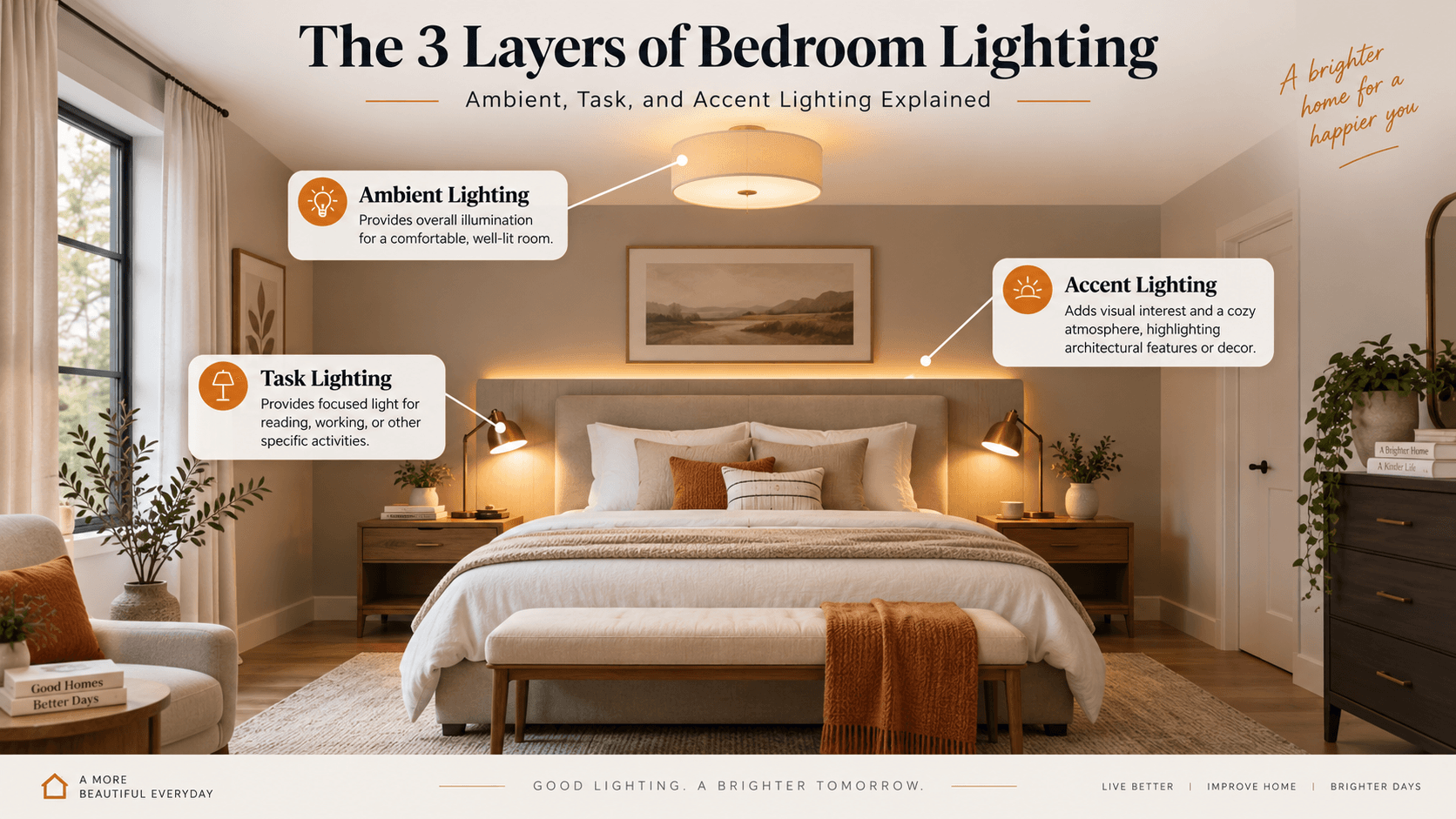
A better setup divides the work between three layers:
- Ambient lighting: general room brightness from a ceiling fixture, pendant, flush mount or indirect light.
- Task lighting: focused light for reading, dressing, makeup or a small desk.
- Accent lighting: softer light that adds depth around artwork, a headboard, shelving or architectural details.
Imagine a 144-square-foot bedroom where you want roughly 2,000 lumens of general usable light. Instead of one harsh 2,000-lumen source directly overhead, you might use a moderate ceiling fixture, then add two bedside lamps and dim them independently. The room can feel brighter where you need it without feeling overlit everywhere.
If nightstand space is limited, plug-in wall sconces can provide bedside task light without using the tabletop. If you prefer a conventional setup, see our bedroom table lamp guide.
How Many Lumens Do You Need for Reading in Bed?
Reading light should be treated separately from the room’s ambient-lumen target. A book only needs good illumination over a small area, so a directional light can be much more effective than making the whole bedroom brighter.
For many bedside setups, a focused reading lamp in roughly the 300–500 lumen range can be enough when positioned close to the page. But distance, beam width, eyesight and shade design matter. A narrow lamp aimed directly at a book may work well with fewer lumens than a shaded lamp several feet away.
The most useful feature is often a dimmer. Set the lamp high enough to read without strain, then reduce it if the page looks overly bright against the dark room.
For portable and partner-friendly options, our guide to the best reading lights for bed covers neck lights, clip-ons and headboard lights.
What Color Temperature Is Best for Bedroom Lighting?
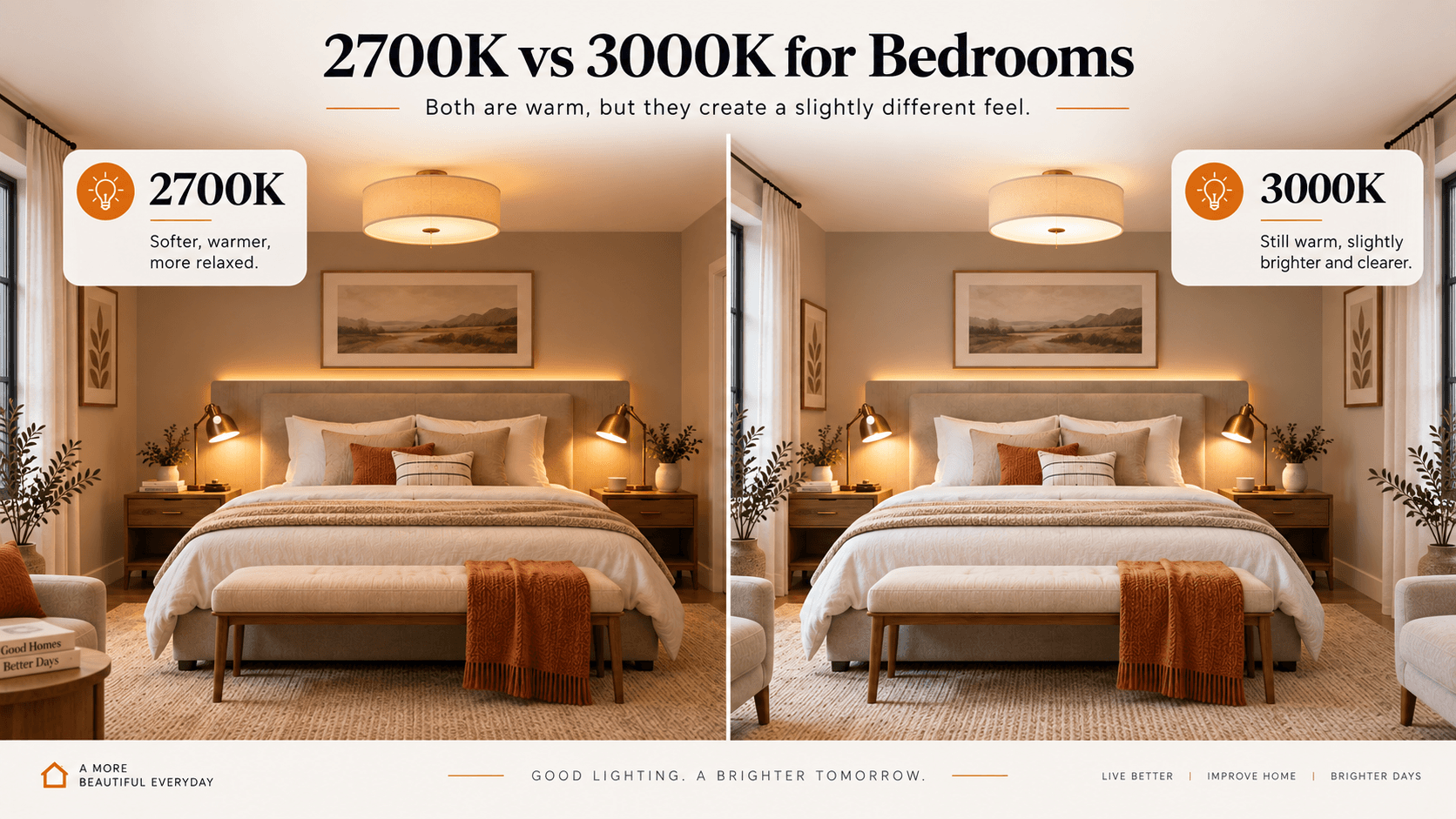
Lumens measure brightness. Kelvin measures the color appearance of the light. They solve different problems.
For most bedrooms, 2700K to 3000K is a practical range because it gives the room a warm white appearance. The Department of Energy describes 2700K as warm and 3000K as a soft, warm-looking light commonly suited to homes.
Cooler light can be useful at a vanity, wardrobe or workspace where visual clarity matters, but using very cool daylight-style light throughout the bedroom can make the room feel more like an office than a place to relax.
If you want to change brightness and tone during the day, a smart bedside lamp can be useful. Our smart bedside lamp guide includes options with adjustable brightness and color settings.
When a Bedroom May Need More or Less Light
The 10–20 lumens-per-square-foot guideline is intentionally broad. Real rooms do not behave like a calculator.
Dark walls and furniture
Dark paint, dark wood and heavy fabrics absorb more light than pale walls and light bedding. If your room has a deep charcoal, navy or brown palette, you may feel more comfortable toward the higher end of the range.
High ceilings
A fixture mounted farther from the surfaces you use can feel less effective even when its lumen rating is unchanged. A bedroom with tall ceilings may benefit from more output, better fixture placement or added lamps at eye level.
Older eyes or detailed tasks
Comfortable brightness is personal. Reading fine print, sewing, getting dressed or working at a desk can require more task light than sleeping and relaxing.
Large windows
A bright bedroom may need very little artificial light during the day but still require a complete lighting plan after sunset. Do not size nighttime lighting only by how the room looks at noon.
Very small rooms
A compact bedroom can feel uncomfortable when a high-output ceiling fixture is used at full brightness. In small spaces, lower ambient output plus targeted bedside lighting often works better.
Common Bedroom Lumen Mistakes
Choosing one extremely bright bulb
Total lumens do not tell you where the light lands. One strong source can create glare and deep shadows at the same time.
Buying by watts
With LEDs, wattage is mainly an energy-use number. Compare lumens when you want to compare brightness.
Ignoring dimming
The ideal bedroom brightness at 7 a.m. is rarely the ideal brightness at 11 p.m. Dimming gives one lighting setup a much wider useful range.
Using only overhead lighting
Bedside lighting makes reading and nighttime movement easier without forcing the entire room to stay bright. A small bedroom night light can also handle late-night navigation without switching on the main fixture.
Mixing random color temperatures
A 2700K bedside lamp next to a very cool 6000K ceiling bulb can make the room feel visually inconsistent. You do not need every source to match exactly, but keeping the main bedroom lights in a related warm range usually looks more intentional.
Frequently Asked Questions
Is 800 lumens enough for a bedroom?
It can be enough for a very small bedroom or as one part of a layered setup. In a 100-square-foot bedroom, 800 lumens alone is below the 10–20 lumens-per-square-foot starting range, but additional bedside lamps can raise the usable total.
Is 1,500 lumens bright enough for a bedroom?
For many small to medium bedrooms, yes. A 120-square-foot bedroom at 1,500 lumens works out to about 12.5 lumens per square foot, which sits inside the practical starting range. Placement and dimming still matter.
Is 2,000 lumens too bright for a bedroom?
Not necessarily. In a 150-square-foot room, 2,000 lumens is only about 13 lumens per square foot. The same 2,000 lumens in a tiny 70-square-foot room may feel much brighter. How the light is distributed matters as much as the total.
How many lumens for a 10 × 10 bedroom?
A 10 × 10 bedroom is 100 square feet. Using 10–20 lumens per square foot gives a starting ambient range of about 1,000–2,000 lumens.
How many lumens for a 12 × 12 bedroom?
A 12 × 12 bedroom is 144 square feet. A practical starting range is about 1,440–2,880 lumens of ambient light.
Should bedside lamps count toward total bedroom lumens?
They contribute to the light in the room, but it is more useful to think of them as task or local lighting rather than simply adding every lumen rating together. Shades, direction and distance can make the same rated output feel very different.
What is the best bedroom brightness for sleep?
There is no single lumen number for sleep because the goal near bedtime is usually lower, warmer light rather than a fixed room-wide brightness. Dimmable 2700K–3000K lighting lets you reduce the room’s output as bedtime approaches.
Final Thoughts
If you only remember one number, use 10–20 lumens per square foot as a simple starting point for bedroom ambient lighting. Then adjust for the room rather than treating the result as a rule.
A bedroom usually feels better when brightness is divided between a moderate ambient source and focused task lights. Add more light where you read or dress. Keep evening lighting dimmable and warm. And when choosing LED bulbs, compare lumens for brightness rather than relying on watts.
Once the lumen range is roughly right, fixture placement has a bigger effect on comfort than chasing another hundred lumens.